

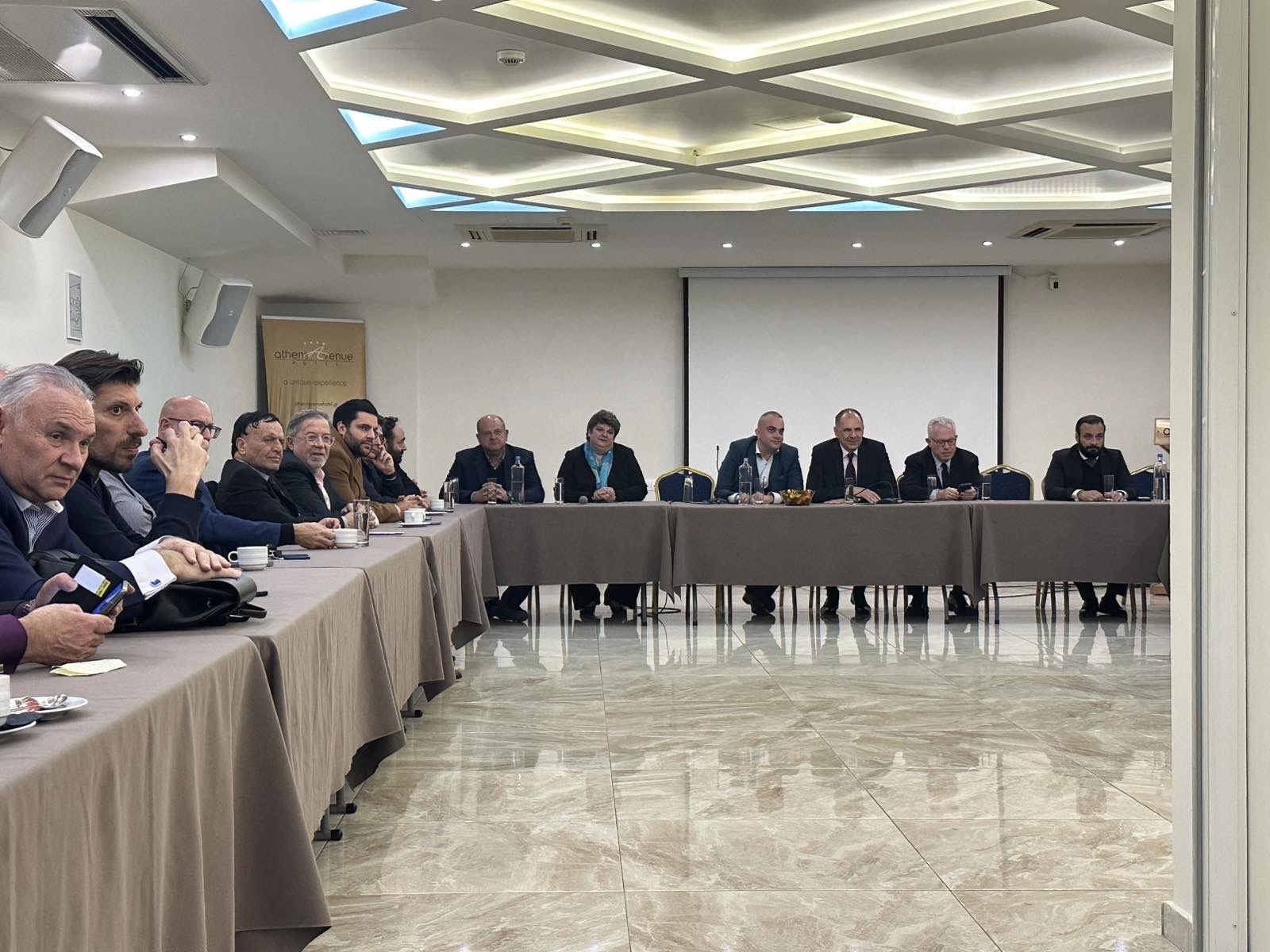
Tag: Business Meeting

  • Strategic Insights from the Meeting with Foreign Minister Giorgos Gerapetritis

    Strategic Insights from the Meeting with Foreign Minister Giorgos Gerapetritis

    Summary

    On January 12, 2026, members of the PIGI Business Platform attended a high-level policy meeting in Athens with Greek Foreign Minister Giorgos Gerapetritis.

    The discussion focused on Greece’s geopolitical positioning, economic diplomacy, regional security, energy investments, export strategy, and international business expansion. The Minister emphasized that Greece is entering a period of increased geopolitical importance and economic consolidation, creating new opportunities for Greek businesses and internationally oriented SMEs.

    For PIGI members, the meeting highlighted important opportunities in exports, renewable energy, infrastructure, technology, and cross-border partnerships.

    Greece’s Strategic Position in a Changing Global Environment

    During the meeting held in Athens, Foreign Minister Giorgos Gerapetritis emphasized that modern governance must focus on serving citizens and supporting economic development rather than creating institutional limitations.

    According to the Minister, the international order established after World War II is undergoing major structural changes. In this increasingly unpredictable environment, Greece has emerged as a strategically important country due to its geographical position connecting the Balkans, Eastern Mediterranean, Middle East, and Black Sea regions.

    Foreign Policy and International Alliances

    The Minister described Greek foreign policy as being based on:

    • Realism
    • Patriotism
    • Empathy

    He highlighted the strong strategic relationship between Greece and the United States, continued cooperation with Israel, and constructive relations with Italy.

    Regarding Turkey, the Minister stated that despite structural disagreements, Greece continues to maintain dialogue and economic cooperation channels while protecting its national interests.

    Security Challenges and Regional Risks

    The discussion also addressed the growing geopolitical risks affecting the region, including:

    • The war in Ukraine
    • Instability in the Middle East
    • Iran-related tensions
    • China’s increasing global influence
    • Migration pressures from Africa

    The Minister stressed that national security today depends on multilayered alliances, active diplomacy, and strategic international partnerships.

    Economic Diplomacy and Business Opportunities

    One of the key topics for PIGI members was Greece’s economic diplomacy strategy.

    The Ministry of Foreign Affairs is strengthening its role in trade promotion, export support, and international business development. The government plans to organize regular business missions to strategic markets while improving export-credit mechanisms and investment guarantee systems.

    Greek companies are increasingly recognized internationally as reliable and institutional business partners.

    For SMEs and entrepreneurs, the coming years may create significant opportunities in:

    • Export development
    • International partnerships
    • Innovation and technology
    • Renewable energy projects
    • EU-funded initiatives

    Energy Investments and Regional Connectivity

    Greece is also positioning itself as a regional energy hub through major projects including:

    • Renewable energy investments
    • The Greece–Cyprus–Israel electricity interconnection
    • Energy corridors connecting Africa and Europe through Greece

    The Minister emphasized that investments by major American energy companies also represent geopolitical confidence in Greece’s strategic future.

    Conclusion

    The meeting demonstrated that Greece is strengthening its political, diplomatic, and economic influence in a rapidly changing international environment.

    For PIGI members, this evolving landscape presents important opportunities for international growth, innovation, exports, and strategic investment partnerships.

  • Pavlos Geroulanos on Greece’s Triple Crisis and the Strategic Importance of Small Businesses

    Pavlos Geroulanos on Greece’s Triple Crisis and the Strategic Importance of Small Businesses

    Summary

    In a recent policy discussion, Pavlos Geroulanos addressed what he described as Greece’s “triple crisis”: institutional instability, structural economic inequality, and geopolitical uncertainty.

    The speech strongly emphasized the importance of small and medium-sized enterprises (SMEs), entrepreneurship, and social cohesion as key drivers for Greece’s long-term recovery and democratic resilience.

    According to Geroulanos, Greece’s future depends on building a more inclusive economic model capable of supporting productive businesses, restoring institutional trust, and reducing inequalities created by the current system.

    The Importance of Small Businesses

    At the center of the discussion, Pavlos Geroulanos highlighted his strong belief in the value of small businesses and entrepreneurship.

    He argued that small enterprises are often more adaptable, innovative, and effective than large corporate structures. Entrepreneurship, according to the speaker, should not be viewed only as an economic activity but also as a social and democratic force that strengthens communities and resilience.

    Greece’s Triple Crisis

    The speech focused on three interconnected crises currently affecting Greece.

    1. Reputation and Entrepreneurship Crisis

    The first challenge concerns the country’s negative business environment and the broader perception surrounding entrepreneurship in Greece.

    The speaker argued that entrepreneurs operating successfully under such difficult conditions demonstrate exceptional resilience and adaptability.

    2. Structural Economic Crisis

    The second challenge relates to economic inequality and weaknesses within the current economic model.

    Concerns were raised regarding:

    • Non-performing loans
    • Unequal wealth distribution
    • Limited circulation of investment capital into the real economy
    • The inability of many social groups to benefit from economic growth

    According to the discussion, while significant investments have entered Greece in recent years, large parts of society still remain excluded from the resulting prosperity.

    3. Geopolitical and Foreign Relations Challenges

    The third crisis concerns Greece’s geopolitical position and international relations.

    Although Greece remains an important member of the European Union and Western alliances, shifting global dynamics and regional instability continue to create strategic uncertainty.

    The speech also emphasized concerns regarding excessive dependency on specific geopolitical alignments while regional power balances continue to evolve.

    Institutional Trust and Democratic Stability

    One of the most important themes of the discussion was institutional functionality and public trust.

    The speaker argued that when citizens lose confidence in political institutions and democratic processes, governments face increasing difficulties in implementing legitimate and effective crisis solutions.

    This creates a cycle where institutional distrust further weakens political and economic stability.

    The Need for a Comprehensive Social and Economic Program

    The speech concluded with a call for a broader social and political strategy capable of addressing Greece’s structural problems.

    According to the speaker, future policy priorities should include:

    • Supporting productive SMEs
    • Reducing economic inequality
    • Strengthening institutional trust
    • Expanding opportunities for younger entrepreneurs
    • Building a more socially inclusive economic model

    Conclusion

    The discussion presented a critical but constructive perspective on Greece’s current institutional, economic, and geopolitical challenges.

    At the same time, it emphasized that supporting innovative small businesses and creating a more inclusive development strategy could become the foundation for Greece’s long-term stability, competitiveness, and democratic resilience.